Smog season is here, and the right air purifier makes a measurable difference indoors. The wrong one just hums in the corner. This air purifier buying guide explains how to choose an air purifier for an Indian home in 2026: how much CADR your room needs, why HEPA H13 matters, what filters really cost each year, and how to pay less with coupons and bank offers.
Do you need an air purifier?
If the AQI in your city regularly stays above 100, an air purifier is worth it, especially in bedrooms where you spend 7–8 hours a night. North Indian cities such as Delhi-NCR, Lucknow and Patna often cross 300 in November and December. Families with children, older parents, asthma or dust allergies benefit the most.
A purifier cleans the air inside one closed room. It does not fix outdoor air, so keep doors and windows closed while it runs during high-AQI hours.
Step 1: Match CADR to your room size
CADR (Clean Air Delivery Rate) is the volume of filtered air a purifier delivers every hour, shown in m³/h. It is the single most important number on the box, and more useful than the "suitable for 500 sq ft" claim, which brands calculate in different ways.
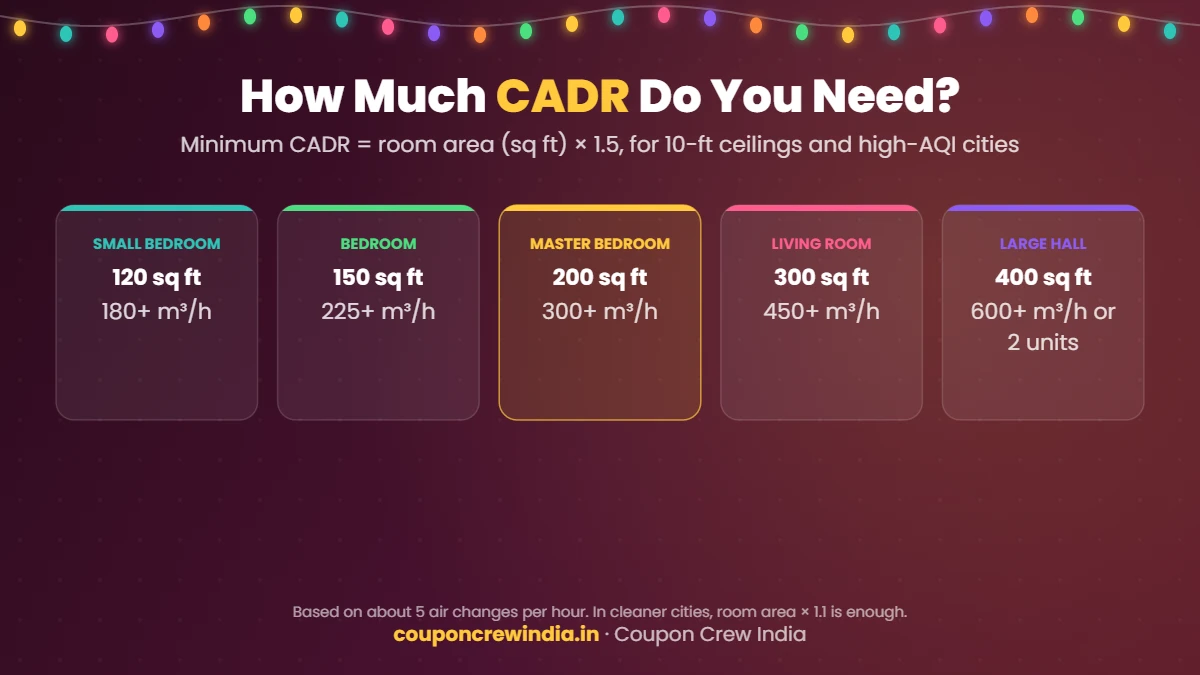
Use this simple rule for Indian homes: minimum CADR (m³/h) = room area (sq ft) × 1.5. It gives about five air changes an hour in a room with a 10-ft ceiling, which is what you want in high-AQI cities. The US appliance body AHAM uses a lighter "two-thirds rule" (smoke CADR in cfm = two-thirds of the room area), which works out to roughly area × 1.1 in m³/h for an 8-ft ceiling. That is fine in cleaner cities.
| Room | Area | Minimum CADR (high-AQI city) | Minimum CADR (moderate AQI) |
|---|---|---|---|
| Small bedroom | 120 sq ft | 180 m³/h | 130 m³/h |
| Bedroom | 150 sq ft | 225 m³/h | 165 m³/h |
| Master bedroom | 200 sq ft | 300 m³/h | 220 m³/h |
| Living room | 300 sq ft | 450 m³/h | 330 m³/h |
| Large hall | 400 sq ft | 600 m³/h (or two units) | 440 m³/h |
Measure length × width in feet. For open-plan rooms, add the connected area. Higher ceilings need more CADR.
Step 2: Check the filters (HEPA H13 + carbon)
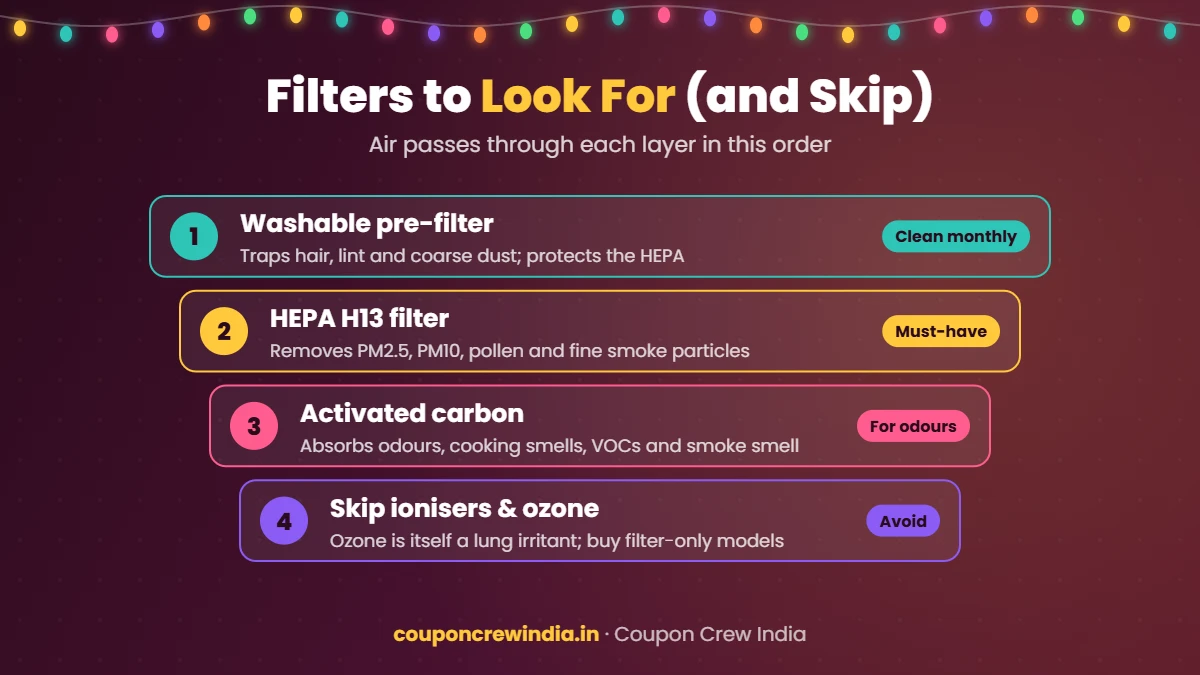
HEPA H13: the filter that removes PM2.5
A HEPA filter traps fine particles such as PM2.5, PM10, pollen and smoke. Under the European EN 1822 standard, an H13 filter captures at least 99.95% of particles at the hardest-to-catch size, and H14 captures 99.995%. US "True HEPA" is rated at 99.97% at 0.3 microns. For homes, H13 is the sweet spot; H14 adds cost with little real-world gain.
Avoid labels like "HEPA-type", "HEPA-like" or "99% HEPA". These are marketing terms, not a filter grade.
Activated carbon: for smells, smoke and VOCs
HEPA does not remove gases. An activated carbon layer absorbs cooking smells, cigarette or incense smoke odour and VOCs from paint and furniture. Heavier carbon (look for the weight in grams) lasts longer.
Washable pre-filter
A mesh pre-filter catches hair, lint and coarse dust before it reaches the HEPA. Rinse it every 2–4 weeks and your HEPA filter lasts noticeably longer.
Step 3: Features worth paying for
- PM2.5 sensor and auto mode: the fan speeds up when AQI rises and slows when the air is clean, saving power and filter life.
- Sleep mode under 35 dB: quiet enough for a bedroom. On high speed, anything under 50 dB is acceptable.
- Filter-life indicator: tells you when to change the filter instead of guessing.
- 360° air intake: pulls air from all sides, so placement is easier.
- App control: handy for switching it on before you get home, but not essential.
Air purifier price in India: what each budget gets you
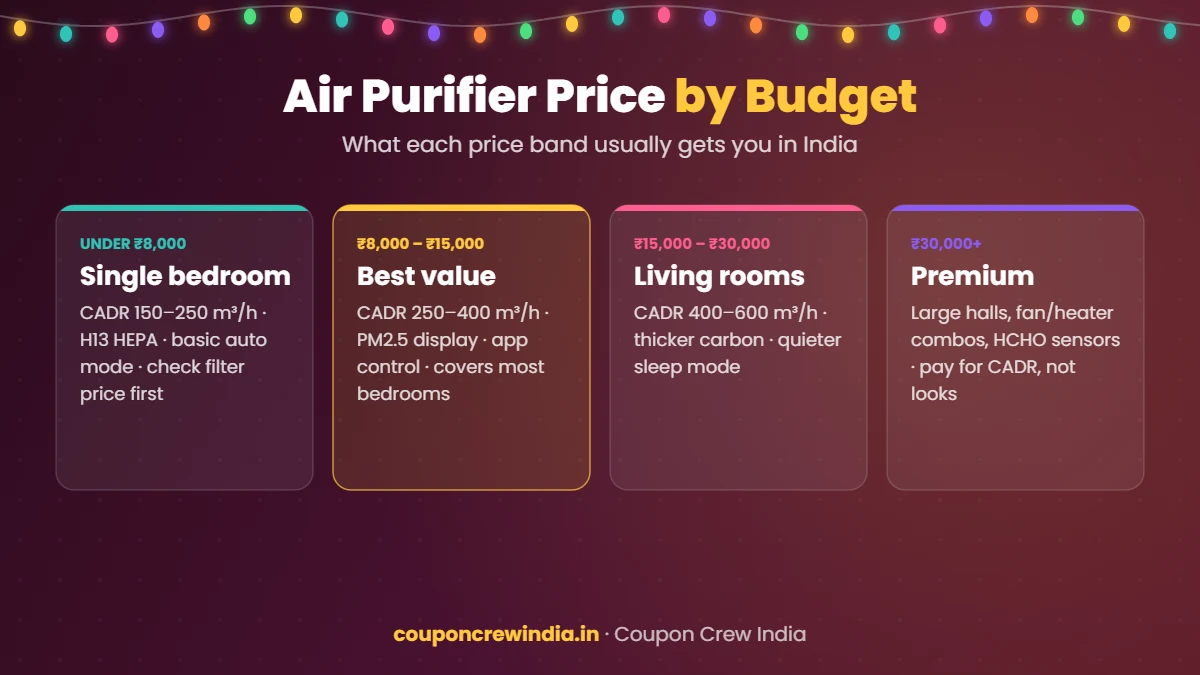
| Budget | Typical CADR | Best for | What to check |
|---|---|---|---|
| Under ₹8,000 | 150–250 m³/h | Small bedrooms, study rooms | Filter price and availability |
| ₹8,000 – ₹15,000 | 250–400 m³/h | Most bedrooms; best value | Sleep-mode noise, PM2.5 sensor |
| ₹15,000 – ₹30,000 | 400–600 m³/h | Living rooms, open plans | Carbon weight, warranty |
| ₹30,000+ | 600+ m³/h or combo devices | Large halls, premium homes | Pay for CADR, not design |
Popular brands in India include Philips, Coway, Xiaomi, Honeywell, Sharp, Eureka Forbes, Blueair, Levoit and Dyson. Compare them on CADR, filter cost and service network, not on brand name alone.
The true cost of owning an air purifier
The sticker price is only part of the cost. Filters and electricity add up every year, so compare two-year costs before you buy.
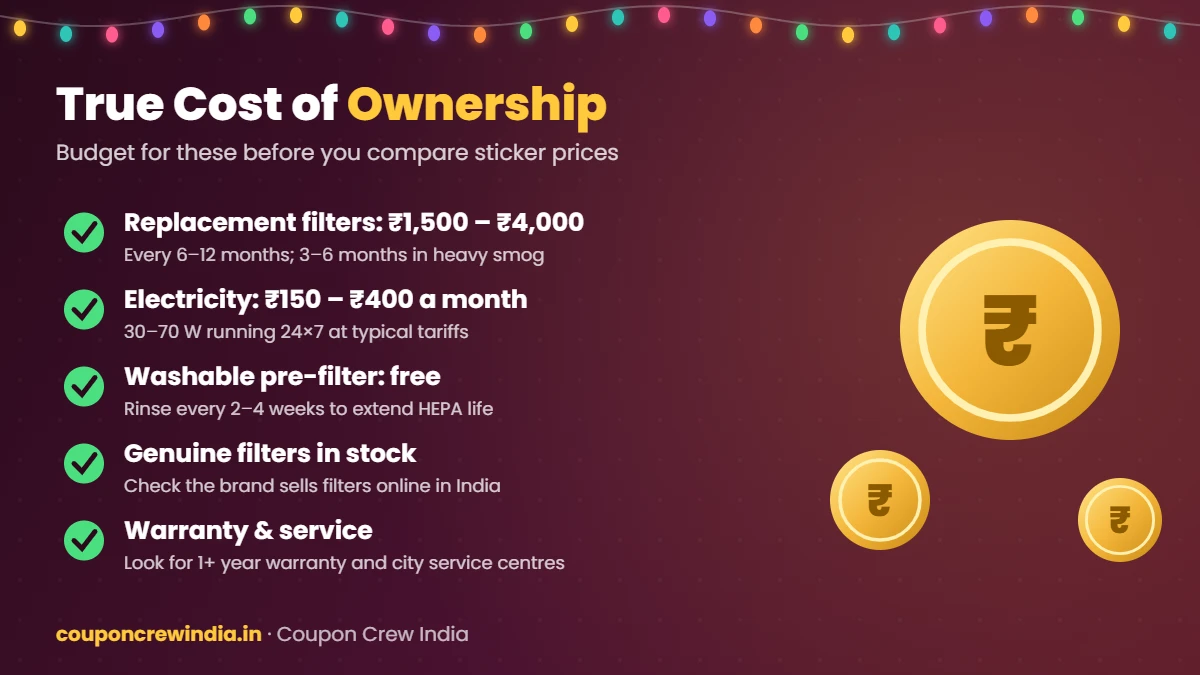
| Cost | Typical amount | How often |
|---|---|---|
| HEPA + carbon filter set | ₹1,500 – ₹4,000 | Every 6–12 months (3–6 months in heavy smog) |
| Electricity (30–70 W, 24×7) | About ₹150 – ₹400 a month | Monthly, depending on your tariff |
| Pre-filter cleaning | Free | Every 2–4 weeks |
Example: a ₹12,000 purifier with a ₹3,000 filter changed twice a year and ₹250 a month of electricity costs about ₹30,000 over two years. A ₹10,000 model with a ₹5,000 filter can end up costing more.
Where to place your air purifier
- Put it in the room you use most, usually the bedroom, and keep doors and windows closed.
- Leave 30–60 cm of space around the intake; do not push it into a corner or behind curtains.
- Run it on auto or high for 30 minutes before you sleep, then switch to sleep mode.
- For a large flat, buy one purifier per room rather than one big unit for the whole home.
7 air purifier buying mistakes to avoid
- Buying by the "sq ft" sticker: check the CADR instead.
- Ignoring filter cost: an expensive or hard-to-find filter makes a cheap purifier costly.
- HEPA without carbon: you will still smell cooking and smoke.
- Ozone or ioniser-heavy models: avoid them in homes with children or asthma patients.
- One purifier for the whole house: it can only clean the room it is in.
- Running it with windows open: it cannot keep up with outdoor air.
- Buying grey-market imports: no warranty, no local filters.
When to buy an air purifier and how to save
Prices tend to rise in November when AQI peaks and demand jumps. If you can wait, the Black Friday sale on 27 November and December year-end sales usually bring better bank offers. If your AQI is already above 200, buy now and focus on stacking savings.

- Compare three stores: Croma, Reliance Digital, Vijay Sales, Amazon, Flipkart and Tata CLiQ often differ by ₹1,000 or more on the same model.
- Apply a verified coupon from our latest coupons, after checking the minimum order value.
- Use a bank or card offer for an instant discount, or no-cost EMI. Check the processing fee before you confirm.
- Look for combo deals that include a spare filter; it saves money in year two.
Your air purifier buying checklist
- Measure the room and calculate minimum CADR (area × 1.5)
- HEPA H13 filter, not "HEPA-type"
- Activated carbon layer for smells and smoke
- Sleep mode under 35 dB
- Replacement filter under about ₹4,000 and sold online in India
- No ozone, or ioniser that can be switched off
- 1+ year warranty with service in your city
- Coupon and bank offer applied before you pay
Frequently asked questions
What CADR do I need for a 200 sq ft room?
For a 200 sq ft room in a high-pollution city, look for a CADR of at least 300 m³/h. In cities with moderate AQI, around 220 m³/h is enough.
Is HEPA H13 better than H14 for home use?
H13 removes at least 99.95% of fine particles and is enough for homes. H14 is slightly more efficient but costs more and usually has a lower CADR at the same price.
How often should I replace an air purifier filter?
Most HEPA and carbon filters last 6–12 months. In heavy smog, such as Delhi in winter, expect 3–6 months. Follow the filter-life indicator and clean the pre-filter every few weeks.
How much electricity does an air purifier use?
Most home purifiers use 30–70 W on medium to high speed. Running one 24×7 typically costs about ₹150–₹400 a month, depending on your tariff.
Should I run my air purifier all day?
Yes, on high-AQI days it is best to run it continuously on auto mode with doors and windows closed. Auto mode lowers the fan speed when the air is clean, saving power and filter life.
Do air purifiers remove smoke and cooking smells?
Only if they have an activated carbon filter. HEPA removes smoke particles, while carbon absorbs the smell and gases.
Are ionisers in air purifiers safe?
Ionisers and ozone generators can release ozone, which irritates the lungs. Choose a filter-only purifier or switch the ioniser off, especially around children and people with asthma.
Which is the best air purifier brand in India?
No single brand is best for every home. Philips, Coway, Xiaomi, Honeywell, Sharp and Eureka Forbes all sell models with HEPA H13 filters. Pick the model with the right CADR for your room, affordable filters and good service in your city.
Prices change daily during smog season. Check our latest coupons and all stores for verified electronics offers, and bookmark this air purifier buying guide for next winter.