North India's winter is setting in, and a room heater can make cold nights far more comfortable. Pick the wrong one, though, and you get a dry, stuffy room, a huge electricity bill or a tripped socket. This room heater buying guide explains how to choose a room heater in India for 2026: which type suits your room, how many watts you need, what it really costs to run each month, which safety features matter, and how to pay less with coupons and bank offers.
Do you need a room heater?
If indoor temperatures in your home drop below about 15°C for several weeks, as they do across Delhi NCR, Punjab, Haryana, UP, Rajasthan, Bihar and the hill states, a heater is worth it. In milder cities, a warm quilt and closing gaps under doors may be enough. If you only feel cold sitting in one spot, a small personal heater from our electronics deals does the job for a fraction of the running cost of heating the whole room.
Step 1: Choose the right type of room heater
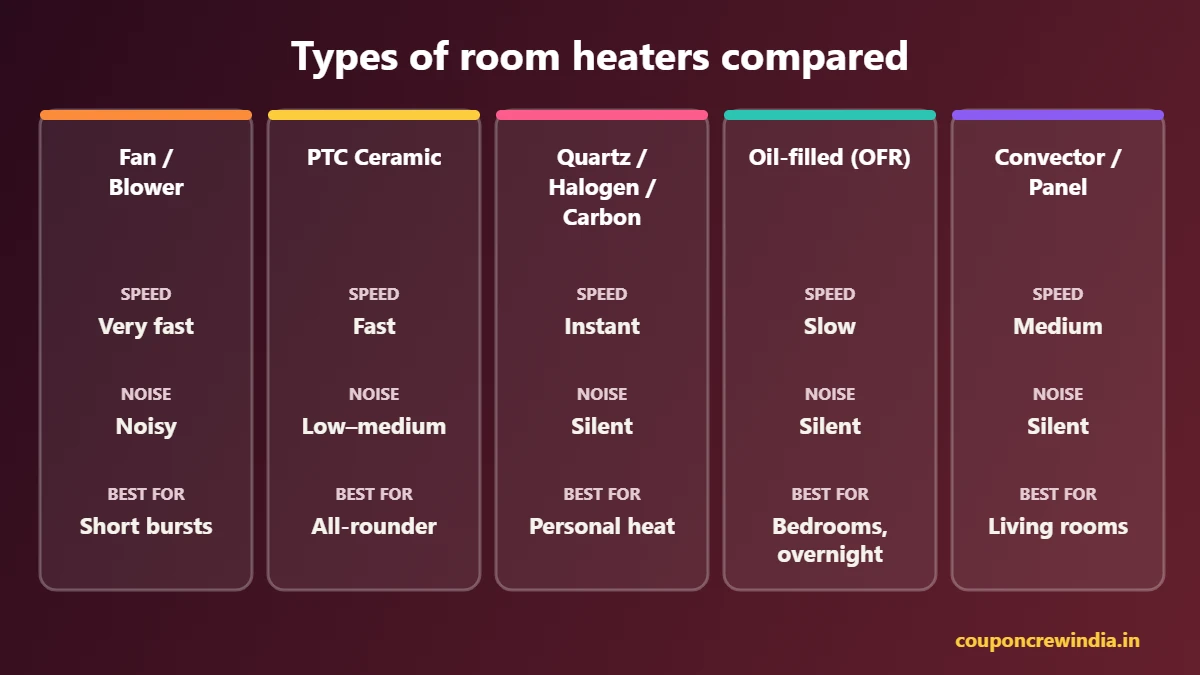
The first step in any room heater buying guide is choosing the type. There are five common types of electric room heater in India, and you'll find all of them on Amazon and Flipkart. They heat in different ways, which is why the "best room heater" depends on how you'll use it.
Fan heater / blower
A fan blows air over a hot coil. It warms a small room in minutes and is cheap to buy, often under ₹1,500, and Lifelong coupons can cut the price further. On the downside it's noisy, dries the air and the heat disappears as soon as you switch it off. Best for short bursts, such as warming a room before you get ready in the morning.
PTC ceramic heater
A fan heater with a ceramic (PTC) element that limits its own temperature, so there's no glowing red coil. It heats quickly, is safer around curtains and children than coil blowers, and many models, such as those from AGARO, have a thermostat. It doesn't use less electricity than other heaters of the same wattage, but its thermostat helps it switch off when the room is warm.
Quartz, halogen and carbon heaters
These are radiant heaters. Like sunlight, they warm the people and objects in front of them rather than the air. They're instant, silent and the cheapest to buy and run (often 400 to 1,200 W). But they only heat in one direction, the glowing rods can burn skin or fabric, and some people find the bright light and dryness uncomfortable. Carbon heaters warm up faster and feel gentler than quartz. Compare models on Tata CLiQ before you buy.
Oil-filled radiator (OFR)
Electricity heats sealed oil inside metal fins, which then warm the room evenly and silently. An OFR takes 15 to 30 minutes to warm up, but it keeps radiating heat after switching off, doesn't burn oxygen and feels the least dry. It's heavy and costs more upfront (check Havells offers to cut the price), but it is the most popular choice for bedrooms, babies and the elderly.
Convector / panel heater
Wall-mountable or free-standing panels that heat air silently by natural convection. They give even heat without a fan and take up little floor space, but are slower than fan heaters. Check Croma for wall-mount options.
| Type | Heats | Speed | Noise | Best for |
|---|---|---|---|---|
| Fan / blower | Air | Very fast | Noisy | Short bursts, small rooms |
| PTC ceramic | Air | Fast | Low to medium | All-rounder, study, living room |
| Quartz / halogen / carbon | People in front | Instant | Silent | Personal heating, desk, sofa |
| Oil-filled radiator | Whole room | Slow | Silent | Bedrooms, overnight, babies, elderly |
| Convector / panel | Whole room | Medium | Silent | Living rooms, offices |
Step 2: Match the wattage to your room size
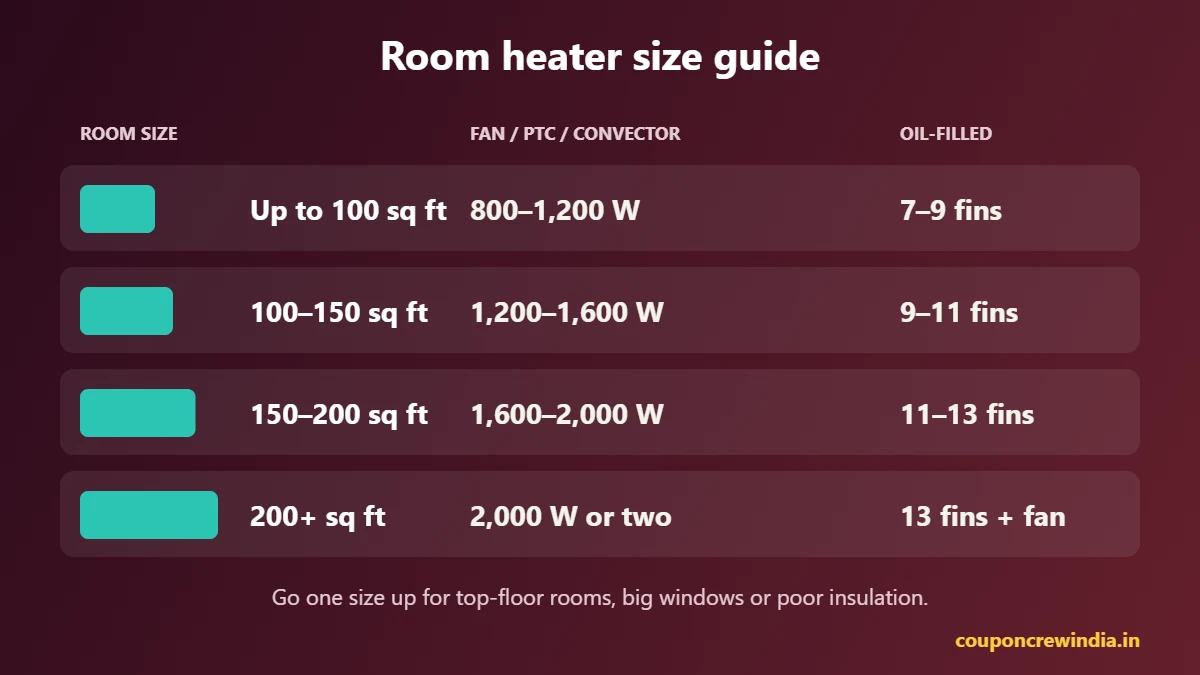
A heater that's too small runs at full power all the time and still leaves the room cold. Use this as a starting point, and go one size up (see our Vijay Sales coupons for bigger models) if the room has big windows, a top-floor ceiling or poor insulation.
| Room size | Example | Fan / PTC / convector | Oil-filled radiator |
|---|---|---|---|
| Up to 100 sq ft | Small bedroom, study | 800–1,200 W | 7–9 fins |
| 100–150 sq ft | Standard bedroom (10×12 ft) | 1,200–1,600 W | 9–11 fins |
| 150–200 sq ft | Master bedroom (14×14 ft) | 1,600–2,000 W | 11–13 fins |
| 200+ sq ft | Living room, hall | 2,000 W or two heaters | 13 fins + a fan heater |
Quartz, halogen and carbon heaters are rated for the person in front of them, not the room, so pick 800 to 1,200 W for personal use from electronics deals.
Step 3: Safety features you shouldn't skip
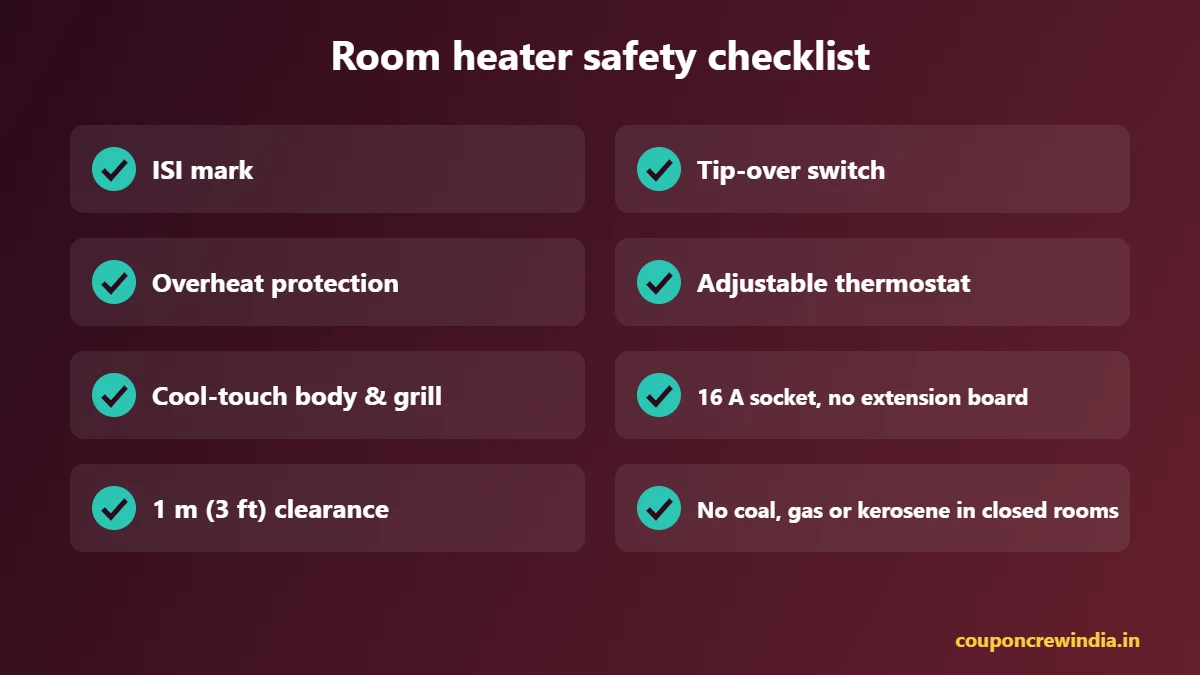
- ISI mark: shows the heater is certified by the Bureau of Indian Standards (BIS). Avoid unbranded, non-ISI heaters, however cheap.
- Tip-over switch: cuts power if the heater falls over. Essential if you have kids or pets.
- Overheat protection (thermal cut-off): switches off the heater if it gets too hot inside.
- Thermostat: switches the heater on and off to hold your set temperature. It's both a safety and a money-saving feature.
- Cool-touch body and safety grill: stops burns from accidental contact.
- Child lock: useful on digital models in homes with small children.
Step 4: Features worth paying for
- Adjustable thermostat rather than just high/low settings.
- Multiple power levels (for example 800/1,200/2,000 W) so you can run on low once the room is warm.
- Timer to switch off automatically after you fall asleep.
- Fan assist on OFRs (a "PTC fan" on the side) to cut the long warm-up time.
- Wheels and a cord wrap for heavy oil-filled heaters.
- Humidifier tray on some models, to reduce dryness.
Skip "eco" and "energy saving" claims unless they come with a real thermostat. All electric heaters turn electricity into heat at almost the same efficiency, so a heater only saves money by running less. Smart buyers also save upfront with verified coupon codes.
Room heater price in India: what each budget gets you
| Type | Typical price (2026) | What you get |
|---|---|---|
| Quartz / halogen | ₹1,000–₹3,500 | 2 to 3 rods, basic switches, tip-over switch on better models |
| Fan / blower | ₹1,200–₹3,000 | 2 heat settings, basic thermostat on some |
| Carbon | ₹2,500–₹5,000 | Faster warm-up, oscillation, often a timer |
| PTC ceramic | ₹2,500–₹6,000 | Adjustable thermostat, tip-over and overheat protection, some with remote |
| Convector / panel | ₹2,500–₹5,000 | Silent, wall-mount option |
| Oil-filled radiator | ₹6,000–₹16,000 | 9 to 13 fins, thermostat, wheels; premium models add fan, timer and digital display |
Prices are approximate online prices and change often during sales. Check current prices and today's coupons before you buy.
Room heater electricity cost: what you'll really pay
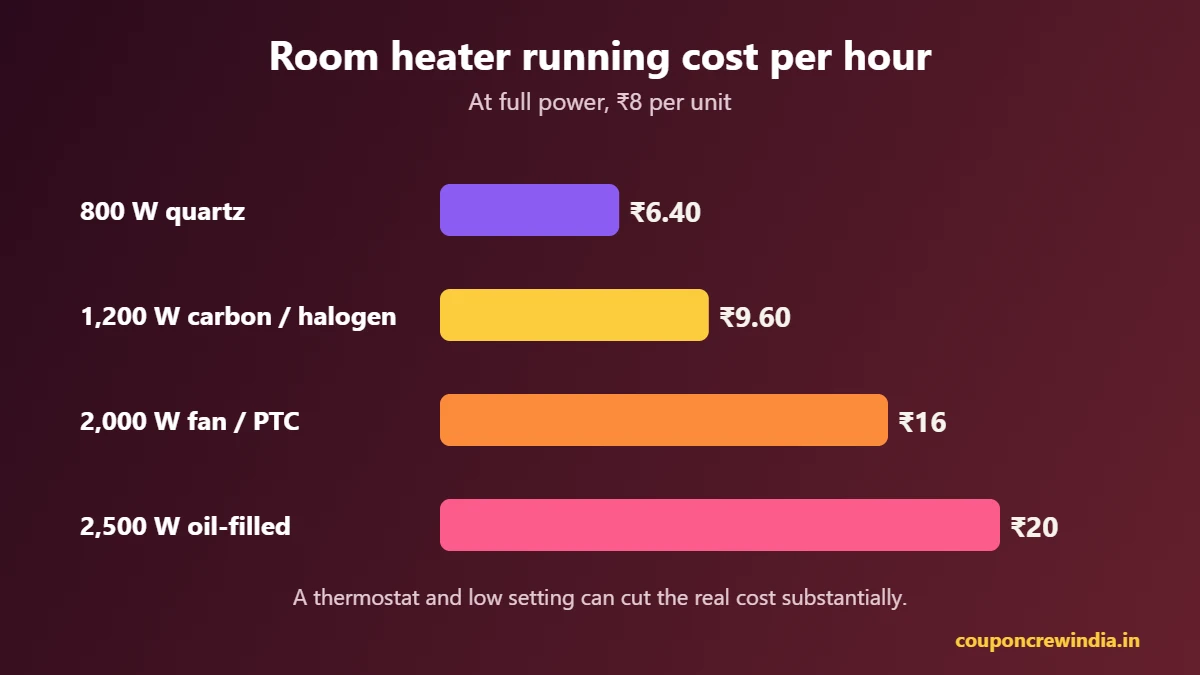
Here's the simple formula: watts ÷ 1,000 × hours × your electricity rate per unit. Most Indian households pay roughly ₹6 to ₹9 per unit in winter, depending on the state and slab. The table uses ₹8 per unit at full power. A thermostat model from Reliance Digital can lower these costs.
| Heater | Cost per hour | 4 hours a day for 30 days | 8 hours a day for 30 days |
|---|---|---|---|
| 800 W quartz | ₹6.40 | ₹768 | ₹1,536 |
| 1,200 W carbon / halogen | ₹9.60 | ₹1,152 | ₹2,304 |
| 2,000 W fan / PTC | ₹16 | ₹1,920 | ₹3,840 |
| 2,500 W oil-filled (11 fins) | ₹20 | ₹2,400 | ₹4,800 |
These are worst-case figures. A heater with a thermostat cycles off once the room is warm, so a thermostat-controlled OFR or PTC heater in a closed room often uses far less than its full rating. Running on the low setting also roughly halves the cost. Buying during the Black Friday sale cuts the purchase price too.
How to cut your heater bill
- Set the thermostat to 20 to 22°C rather than maximum.
- Close doors and windows, and block gaps under the door with a draught stopper or rolled towel.
- Heat only the room you're using, and use a personal heater when you're alone.
- Pre-heat the bedroom for 30 minutes, then switch to low or use the timer.
Wiring and socket check (most guides skip this)
A 2,000 W heater draws about 9 amps, and a 2,500 W OFR about 11 amps. A normal 6 A socket is only safe up to about 1,300 W. You can find heavy-duty 16 A plugs and sockets on Moglix. So:
- Plug any heater above 1,500 W into a 16 A power socket (the bigger 3-pin socket used for geysers and ACs).
- Never use an extension board or multi-plug adapter with a room heater. They overheat and are a common cause of fires.
- If the plug or socket feels hot after use, stop and get the wiring checked by an electrician.
- Avoid running a heater and a geyser on the same circuit at the same time if your MCB trips.
Which room heater is best for…
| Situation | Best choice | Why |
|---|---|---|
| Bedroom, overnight | Oil-filled radiator with thermostat and timer | Silent, no glowing element, even heat |
| Babies and elderly | Oil-filled radiator or PTC with tip-over and child lock | Lowest burn and dryness risk |
| Quick heat before bath or work | PTC fan heater | Warms a small room in minutes |
| Study desk or work from home | Carbon or quartz heater | Cheapest way to warm one person |
| Living room or hall | Large OFR or convector, plus a fan heater for quick warm-up | Even heat across a big space |
| Bathroom | Only a heater specifically rated for bathroom use (IP-rated), fixed by an electrician | Water and ordinary portable heaters don't mix |
Room heater vs AC in heat mode
If you already have an inverter split AC with a heat mode (hot and cold AC), use it. It works as a heat pump and can give two to three times more heat per unit of electricity than any room heater, as long as the outdoor temperature isn't near freezing. A cooling-only AC can't heat. For homes without one, a room heater is far cheaper to buy, and a hot and cold AC only makes sense if you were replacing your AC anyway. If you are, check Croma coupons for hot and cold ACs.
Popular room heater brands in India
- Havells, Bajaj, Usha, Orient Electric and Crompton: wide ranges from budget quartz heaters to OFRs, with large service networks across India.
- Morphy Richards, Philips and Black+Decker: popular for oil-filled radiators and PTC heaters with modern designs.
- AGARO, Lifelong and Orpat: budget-friendly fan, PTC and halogen heaters, sold mostly online.
Whichever brand you pick, check that the exact model has an ISI mark, a thermostat and at least a one-year warranty, and read recent buyer reviews for noise and build quality. Browse all stores for brand offers.
Room heater safety tips
- Keep at least 1 metre (3 ft) of clear space around the heater, away from curtains, bedding and clothes.
- Never dry clothes on or in front of a heater.
- Place it on a flat, hard floor, not on a bed, carpet or rug.
- Don't leave quartz, halogen or coil heaters running while you sleep.
- Keep a window slightly open or the door ajar if you use any heater for long periods.
- Never use coal angithis, kerosene or gas heaters in a closed room. They release carbon monoxide, which can be fatal.
- Switch off and unplug the heater when you leave the room.
Maintenance and storage
- Dust the grill and fan vents every couple of weeks during winter. Dust on hot elements causes a burning smell.
- Check the cord and plug at the start of each season. Replace a heater with a damaged or melted cord.
- A slight smell the first time you switch on a new heater is normal and should go away within an hour.
- Never open an oil-filled radiator or top up its oil. It's sealed for life.
- At the end of winter, clean the heater, let it cool fully, and store it upright in its box in a dry place.
7 room heater buying mistakes to avoid
- Buying on price alone and skipping the ISI mark.
- Choosing a quartz or halogen heater to heat a whole room.
- Buying an OFR with too few fins for a big room.
- Ignoring the thermostat, which is what actually saves electricity.
- Using an extension board or a 6 A socket for a 2,000 W heater.
- Leaving a bare-element heater on overnight near bedding.
- Waiting for the coldest week of December, when prices go up and popular models sell out.
When to buy a room heater and how to save
The best prices are usually from October to mid-November, before peak demand, and during the Black Friday and end-of-season sales. By late December, discounts shrink and stock runs low.
- Compare across stores. Check Amazon, Flipkart, Croma, Reliance Digital, Vijay Sales and Tata CLiQ. The same heater can differ by several hundred rupees.
- Look at brand stores too. Havells, AGARO and Lifelong sometimes run their own winter offers.
- Use a coupon code and a bank offer together for the biggest saving.
- Check the warranty and service network. One to two years of warranty with a service centre in your city matters more than a few hundred rupees.
Running a heater for long hours can dry out indoor air, and winter smog makes it worse. If air quality is a concern at home, read our air purifier buying guide too, or browse today's coupons.
Your room heater buying checklist
- Type chosen for how you'll use it (bedroom, quick heat or personal)
- Wattage or fin count matched to room size
- ISI mark, tip-over switch and overheat protection
- Adjustable thermostat (and a timer for bedrooms)
- 16 A socket available for heaters above 1,500 W
- Warranty of at least 1 year and a local service centre
- Prices compared, coupon and bank offer applied
Frequently asked questions
Which room heater is best for a bedroom?
An oil-filled radiator with a thermostat is the best room heater for a bedroom. It's silent, has no glowing element and keeps the room evenly warm. A PTC ceramic heater with tip-over protection is a good budget alternative. Find bedroom heaters with Amazon coupons.
How many watts of room heater do I need?
Roughly 800 to 1,200 W for rooms up to 100 sq ft, 1,200 to 1,600 W for 100 to 150 sq ft, and 1,600 to 2,000 W for 150 to 200 sq ft. For oil-filled heaters, 9 fins suit a standard bedroom and 11 to 13 fins a master bedroom. See our size guide table above.
Oil filled heater vs fan heater: which is better?
A fan heater is cheaper and warms a room in minutes but is noisy and dries the air. An oil-filled heater costs more and is slower, but gives silent, even, longer-lasting heat. Choose a fan heater for short use and an OFR for long hours or overnight. Compare both with Flipkart offers.
Which is the best room heater in India for saving electricity?
Low-wattage quartz or carbon heaters (400 to 1,200 W) cost the least per hour, but they only warm the person in front of them. To heat a whole room, a heater with a good thermostat will use the least electricity, because it switches off once the room is warm. Pair it with a coupon code to save on the purchase too.
How much does a room heater cost per month?
At ₹8 per unit, a 2,000 W heater running at full power costs about ₹16 an hour, or about ₹1,920 a month at 4 hours a day. With a thermostat and low setting, the real cost is usually much lower. Our festive shopping guide has more ways to save on appliances.
What is the difference between PTC and oil-filled heaters?
A PTC heater uses a self-regulating ceramic element and a fan to warm the room quickly. An oil-filled radiator heats sealed oil inside fins, warming the room slowly but silently and evenly. PTC suits short use; OFR suits long hours and bedrooms. Compare both on Vijay Sales.
How many fins should an oil heater have?
Choose 7 to 9 fins for rooms up to about 120 sq ft, 11 fins for 120 to 180 sq ft and 13 fins for 180 sq ft and above. Check Havells for OFRs in different fin sizes.
Does a room heater reduce oxygen in the room?
Electric room heaters don't burn oxygen. The stuffy feeling comes from dry, warm air in a closed room. Coal, kerosene and gas heaters do burn oxygen and release carbon monoxide, so never use them in a closed room. If air quality worries you, read our air purifier buying guide.
Is it safe to sleep with a room heater on?
Only with an oil-filled radiator or a PTC heater that has a thermostat, tip-over switch and overheat protection, placed away from bedding. Use a timer, keep slight ventilation, and never sleep with a quartz, halogen, coal, kerosene or gas heater on. Look for heaters with timers in electronics deals.
Is a room heater safe for babies?
An oil-filled radiator is the safest choice around babies because it has no exposed element and doesn't dry the air as much. Keep it at least 1 metre from the cot, use the thermostat, and keep the room between about 20 and 22°C. Shop winter baby essentials with FirstCry coupons.
Can I use a room heater in the bathroom?
Not a regular portable heater. Use only a heater designed and rated for bathrooms, installed by an electrician away from water. Look for bathroom-rated heaters and fittings on Moglix.
How we researched this room heater buying guide
We reviewed the top-ranking Indian room heater guides and retailer advice pages, compared recent price data from major Indian retailers and review sites (October to November 2026), and used standard electricity calculations (watts × hours ÷ 1,000 × tariff) for the cost tables. Prices and tariffs vary by store and state, so treat the figures as a guide and check the product page and our latest coupons before buying.