Winter is here, and a good jacket is the one piece of clothing you will wear almost every day until March. But jackets look alike online, so it is easy to buy one that looks warm and still leaves you shivering. This winter jacket buying guide shows you how to pick the right jacket for your city, your budget and your daily routine in 2026. You will also learn where to buy and how to pay less with the latest jacket coupons and bank offers.
Do you really need a new winter jacket?
Start with where you live, because Indian winters are very different from one region to another. Someone in Delhi needs real insulation, but someone in Chennai may only need a light layer for a few evenings. So first check the usual lowest temperature in your city on the India Meteorological Department (IMD) website. Then come back and match it with the jacket types below, or browse the fashion deals on Coupon Crew India.
Next, think about how you will use the jacket. A two-wheeler commute in the morning fog needs wind protection more than thickness. A December trip to Manali needs warmth and water resistance, because snow melts on your jacket. If you only need it for a short holiday, you can also rent or borrow, and spend the money on good thermals and gloves from Decathlon instead.
Step 1: Choose the right type of winter jacket
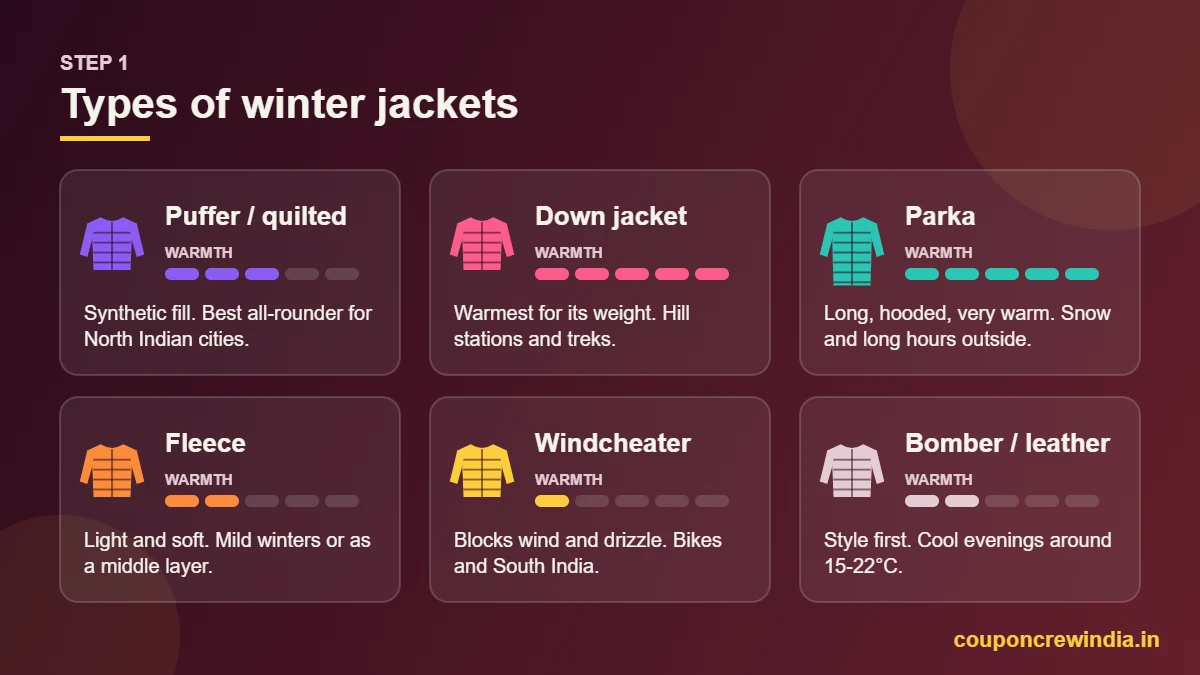
There are six common types of winter jackets in India. Each one is made for a different level of cold. That's why the first step in this winter jacket buying guide is to pick the type, not the colour. You can see all six types side by side on Myntra and AJIO.
Puffer and quilted jackets
A puffer jacket has stitched pockets of filling, so it looks "puffy". Most puffers in India use synthetic (polyester) fill, which stays warm even when it gets a little wet. This makes them the best all-round choice for North Indian city winters. You will find good budget and mid-range puffers at Uniqlo, H&M and Pantaloons.
Down jackets
A down jacket is filled with the soft under-feathers of ducks or geese. Down gives the most warmth for the least weight, and it packs into a small bag. But down loses warmth when it gets soaked, so it needs a water-resistant outer fabric. Down jackets are the best pick for hill stations and treks, and Decathlon and Uniqlo are popular places to buy them.
Parkas
A parka is a long jacket, usually down to the thigh, with a hood that often has a faux-fur trim. The extra length keeps your hips and lower back warm. So a parka is great for very cold places and for people who stand outside for long hours. Check the parka range at Marks & Spencer and Tata CLiQ.
Fleece jackets
A fleece is a soft, brushed polyester jacket. It is light, warm for its price and dries fast. But wind passes through it easily, so it works best as a layer under another jacket or on its own in mild winters. Sports brands like Decathlon and Puma sell good fleece jackets.
Windcheaters
A windcheater is a thin jacket that blocks wind and light rain. It has little or no insulation. That's why it suits bike riders, joggers and people in South India or coastal cities. You can find light windcheaters at Nike and Puma.
Bomber, denim and leather jackets
These are style jackets first. A bomber or denim jacket is fine for 15–22°C evenings. A leather jacket blocks wind very well, but it is not very warm unless it has a padded lining. If style matters most, look at Jack & Jones, Levi's and ONLY.
| Jacket type | Warmth | Weight | Rain/snow | Best for | Approx. price (₹) |
|---|---|---|---|---|---|
| Puffer / quilted (synthetic) | Medium to high | Medium | Handles light wet | Delhi, North India cities | 1,500–6,000 |
| Down jacket | Very high | Light | Needs water-resistant shell | Hill stations, treks, travel | 4,000–15,000+ |
| Parka | Very high | Heavy | Usually good | Snow, long hours outdoors | 3,500–12,000 |
| Fleece | Low to medium | Very light | Poor | Mild winters, middle layer | 800–2,500 |
| Windcheater | Low | Very light | Light rain | Bike rides, South India | 1,000–3,500 |
| Bomber / denim / leather | Low to medium | Medium | Poor to fair | Style, 15–22°C evenings | 1,500–15,000 |
Prices in this table are approximate ranges seen on Indian shopping sites. They change a lot by brand and during sales, so always compare the final price after applying a coupon.
Step 2: Match the jacket to your city's temperature
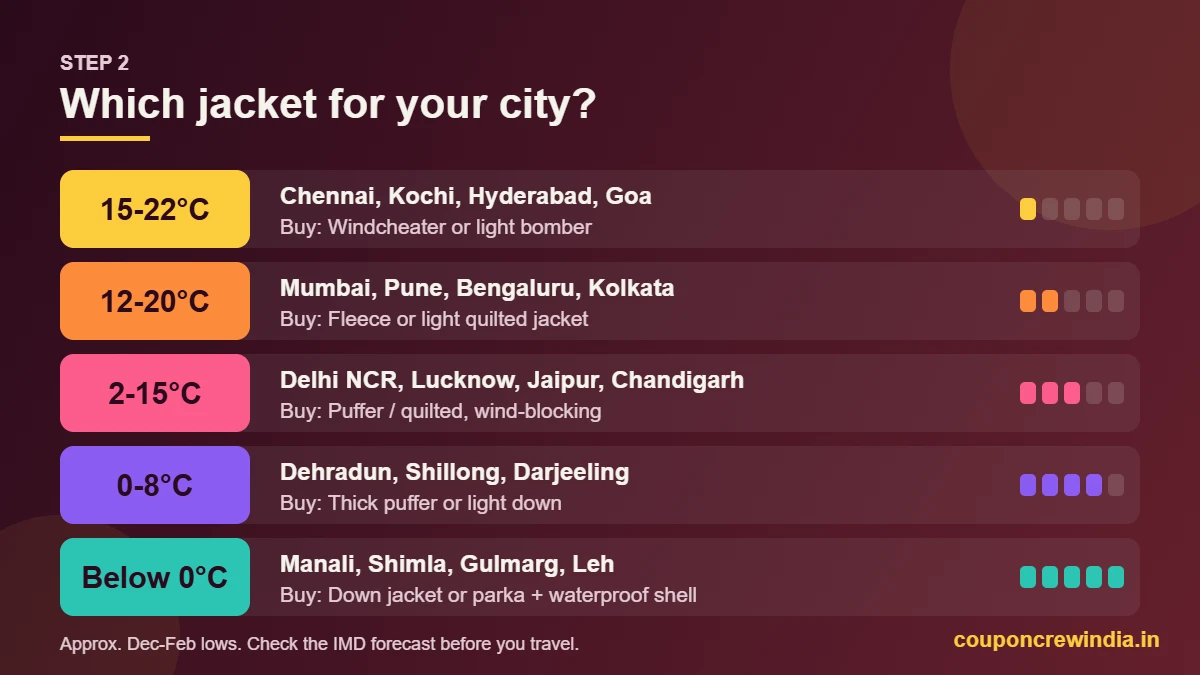
The easiest way to choose a winter jacket is to match it to the lowest temperature you will face. A jacket that is too warm makes you sweat in a Metro coach. A jacket that is too thin is useless on a foggy Delhi morning. Use the table below as a simple guide, then filter by type on Myntra or Amazon.
| Where you are | Usual winter low (approx.) | Jacket to buy | Must-have features |
|---|---|---|---|
| Chennai, Kochi, Hyderabad, Goa | 15–22°C | Windcheater, light bomber, fleece | Breathable fabric |
| Mumbai, Pune, Bengaluru, Kolkata | 12–20°C | Fleece, light quilted jacket, bomber | Light weight, easy to carry |
| Delhi NCR, Lucknow, Jaipur, Chandigarh, Patna | 2–15°C | Puffer / quilted jacket | Wind-blocking shell, high collar, hood |
| Dehradun, Mussoorie, Shillong, Darjeeling | 0–8°C | Thick puffer or light down jacket | Hood, water resistance |
| Manali, Shimla, Auli, Gulmarg, Leh | Below 0°C | Down jacket or parka | Hood, waterproof shell, long length |
Temperatures are rough averages for December to February. Cold waves can push them lower, so check the IMD forecast before a trip. If you are going to a hill station, our travel deals page can also help you save on hotels and flights.
Step 3: Understand insulation – down vs synthetic
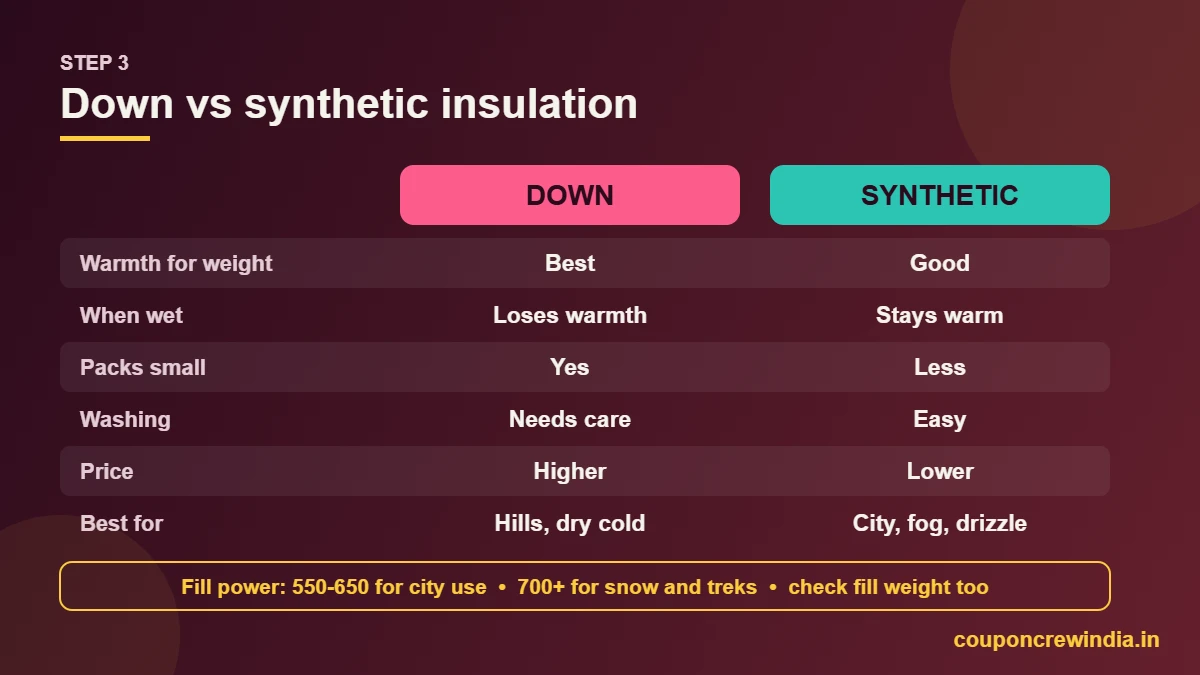
Insulation is the filling inside the jacket. It traps warm air from your body, and that trapped air keeps you warm. There are two main kinds, down and synthetic, and both have clear strengths. You can compare both kinds side by side at Decathlon, which lists the fill type on every product page.
What is fill power?
Fill power tells you how fluffy and good the down is. It usually ranges from about 450 to 900. A higher number means more warmth for the same weight, and the jacket packs smaller. For city use, 550–650 fill power is enough. For serious cold or treks, look for 700 or above, which you will mostly find in premium jackets on Tata CLiQ and Amazon.
Fill weight matters too
Fill power is not the full story. Fill weight is how many grams of filling the jacket has. A jacket with lots of 650-fill down can be warmer than a thin jacket with 850-fill down. So read both numbers on the label. Synthetic jackets often show fill in grams per square metre (GSM), and 100–200 GSM suits most North Indian cities. If a listing hides these details, ask the seller or pick another product on Myntra.
Down or synthetic: which should you buy?
Buy down if you want the warmest, lightest jacket for cold, dry places. Buy synthetic if you face fog, drizzle or snow-melt, or if you want easy washing and a lower price. Most people in Indian cities are happy with synthetic. Also note that many brands now sell "down-free" or recycled fill jackets for buyers who avoid animal products, and you will find these at Uniqlo and H&M.
| Feature | Down | Synthetic |
|---|---|---|
| Warmth for its weight | Best | Good |
| When wet | Loses warmth | Stays warm |
| Packs small | Yes | Less |
| Washing | Needs care | Easy |
| Price | Higher | Lower |
| Life with care | Many years | A few seasons to many years |
| Best for | Hill stations, dry cold, treks | City commutes, foggy and wet weather |
Step 4: Check the shell fabric and weather protection
The shell is the outer fabric of the jacket. It blocks wind and water. Most jackets use nylon or polyester shells, which are light and strong. Some cheap jackets have warm filling but a loose shell, so the wind cuts through. That's why you should read the fabric details on the product page at AJIO or Tata CLiQ before you add to cart.
Water-resistant vs waterproof
Water-resistant means the jacket handles light drizzle or dry snow for a short time. Waterproof means it keeps out steady rain or wet snow. Waterproof jackets show a rating in millimetres (mm). Around 5,000 mm is fine for light rain, 10,000 mm suits snow and heavy rain, and 20,000 mm is for extreme weather. For a Manali trip, aim for 10,000 mm or more, which you will find in trekking ranges at Decathlon.
| Waterproof rating | What it handles | Good for |
|---|---|---|
| Below 5,000 mm | Light drizzle, dry snow | City use |
| 5,000–10,000 mm | Moderate rain, light snow | Hill station sightseeing |
| 10,000–20,000 mm | Heavy rain, wet snow | Snow trips, treks |
| 20,000 mm+ | Extreme weather | High-altitude treks |
Breathability
A jacket also needs to let sweat out. Otherwise you feel damp inside, and damp skin feels cold. Breathability is shown in grams (g/m²), and a higher number breathes better. This matters if you trek, walk a lot or ride a bike, so check it on sports jackets from Nike and Puma.
Step 5: Look for features that really keep you warm
Small details make a big difference on a cold morning. A good jacket seals in heat at the neck, wrists and waist. So check each of these features in the product photos on Myntra or Nykaa Fashion before you buy.
- Hood: an adjustable or detachable hood keeps your head and ears warm.
- High collar: covers your neck and stops cold air from entering.
- Storm flap: a strip of fabric over the zip that blocks wind.
- Rib-knit or elastic cuffs: keep cold air out of your sleeves.
- Drawcord hem: lets you tighten the bottom of the jacket.
- Fleece-lined pockets: warm hands without gloves.
- Inner pocket: keeps your phone safe and its battery warmer.
- Two-way zip: useful in long jackets, so you can sit or ride comfortably.
- Reflective strips: help you stay visible on foggy roads.
- Strong stitching and a good zip: cheap zips are the first thing to break.
Step 6: Get the right size and fit
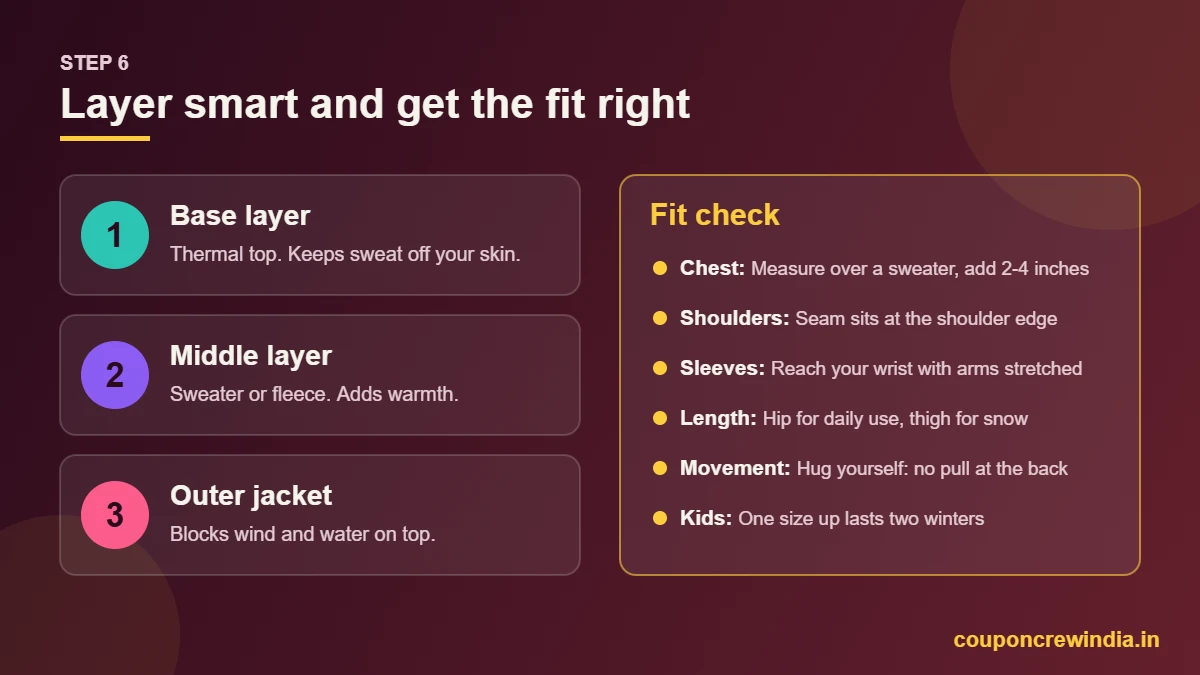
A winter jacket must fit over your sweater, not just over a T-shirt. So measure your chest while wearing a thin sweater. Then pick a size that gives you about 2–4 inches of extra room. Always open the size chart on AJIO or Myntra, because sizes change from brand to brand.
- Shoulders: the seam should sit at the edge of your shoulder, not hang down.
- Sleeves: stretch your arms forward. The cuffs should still reach your wrist.
- Length: hip length for daily use and bikes, thigh length for snow and long hours outside.
- Movement: hug yourself. If the back feels tight, go one size up.
- International sizes: some foreign brands run small or large, so read reviews about fit.
Women's jackets often have a shaped waist and shorter sleeves, so do not pick a men's size by guess. For women's winter wear, see the ranges at Nykaa Fashion and ONLY. For kids, buy one size up so the jacket lasts two winters, and check FirstCry for kids' jackets with soft linings and easy zips.
Layering: the secret to staying warm
Layering means wearing a few thinner layers instead of one very thick jacket. A thermal base layer keeps moisture off your skin. A sweater or fleece adds warmth. Then the jacket blocks wind and water on top. This way you can remove a layer indoors and add it back outside, and you can find all three layers at Decathlon or Marks & Spencer.
Which winter jacket is best for you?
Use this table to pick fast. Find your situation, then look at the jacket and features we suggest. Each row also points to a store where that type is easy to find, and you can see more on our all stores page.
| Your situation | Best jacket | Look for | Where to start |
|---|---|---|---|
| Office commute by Metro in Delhi | Mid-weight puffer | Slim fit, packable, neutral colour | Uniqlo |
| Two-wheeler rider in North India | Quilted jacket with wind-blocking shell | High collar, elastic cuffs, reflective strips | Decathlon |
| Manali, Shimla or Kashmir trip | Down jacket or parka | Hood, 10,000 mm+ waterproof, 650+ fill | Decathlon |
| Ladakh or high-altitude trek | Heavy down jacket + shell | 700+ fill, adjustable hood, packable | Tata CLiQ |
| Mumbai, Bengaluru or Pune evenings | Fleece or bomber | Light weight, breathable | H&M |
| College student on a budget | Synthetic puffer or hooded jacket | Under ₹2,500, washable | Bewakoof |
| Weddings and parties | Wool-blend overcoat or leather jacket | Tailored fit, lined | Louis Philippe |
| Women who want style and warmth | Long puffer or belted coat | Shaped waist, hood | Nykaa Fashion |
| Kids and school runs | Hooded puffer | Soft lining, easy zip, one size up | FirstCry |
| Running and morning walks | Windcheater or light fleece | Breathable, reflective | Nike |
How to wash and care for your winter jacket
Good care can make a jacket last many winters. The first rule is simple: follow the care label inside the jacket. The tips below cover the most common cases, and if you need a new jacket after all, check our fashion coupons first.
- Synthetic puffers: machine wash on a gentle cold cycle, then dry in shade.
- Down jackets: wash rarely, use a mild or down-safe detergent, and dry fully. Tumble dry on low with two clean tennis balls to fluff the down, if the label allows.
- Fleece: wash inside out in cold water and skip fabric softener.
- Leather: never machine wash. Wipe with a damp cloth and use a leather conditioner.
- Waterproof shells: when water stops beading on the surface, use a re-proofing spray.
- Storage: store clean and dry, on a wide hanger or loosely folded. Do not keep down jackets squeezed in a tight bag for months.
9 winter jacket buying mistakes to avoid
Most bad jacket purchases happen for the same few reasons. Avoid these and you will save money and stay warm. Also read our room heater buying guide if you want to keep your home warm this winter too.
- Buying for looks only. A stylish jacket with thin fill will not help on a 4°C morning.
- Buying a size that fits a T-shirt. You will wear a sweater under it, so leave room.
- Ignoring wind. On a bike, a wind-blocking shell matters more than thickness.
- Taking a down jacket into wet snow with no shell. Wet down stops keeping you warm.
- Buying a heavy parka for Mumbai or Bengaluru. You will hardly ever wear it.
- Trusting the word "waterproof" without a rating. Look for a number in mm.
- Not reading the return policy. Check if the jacket can be returned or only exchanged.
- Skipping reviews about fit. Real buyers tell you if a brand runs small.
- Paying full price. Jackets go on sale often, so always check for a coupon first.
When to buy a winter jacket and how to save
The best time to buy depends on how soon you need it. New winter collections arrive around October and November, so you get the most choice then. Big sale events, like the Black Friday sale in late November, are a good time to buy before peak cold. End of season sales usually start around December and January, and prices drop more, but popular sizes sell out fast.
Here are simple ways to pay less. Compare the same jacket on two or three sites, because prices often differ. Then use a store coupon, a bank card offer and a sale price together where the site allows it. You can find current deals on Myntra coupons, AJIO coupons, Flipkart offers and Amazon offers.
Brand stores can also be worth checking. Brands like Decathlon, Uniqlo, Puma and Levi's run their own sales and first-order offers. If you are buying winter outfits for a function, our wedding shopping guide has more ways to save.
Winter jacket buying checklist
Run through this list before you click "Buy". If a jacket ticks most of these boxes, it is a good pick. Then head to the fashion category to grab a deal.
- I know the lowest temperature I will face.
- I picked the right type: puffer, down, parka, fleece, windcheater or bomber.
- I checked the fill type, fill power (for down) or GSM (for synthetic).
- The shell blocks wind, and it is water-resistant or waterproof if I need it.
- It has a hood or high collar, good cuffs and a strong zip.
- I measured my chest over a sweater and checked the size chart.
- I read the reviews about fit and quality.
- I checked the return or exchange policy.
- I compared prices on at least two sites.
- I applied a coupon or bank offer.
Frequently asked questions
How do I choose a winter jacket in India?
First, check the lowest temperature in your city or trip destination. Then pick the jacket type for that temperature, check the insulation and shell, and buy a size that fits over a sweater. This winter jacket buying guide covers each step, and you can compare options on Myntra.
Which is better, a puffer jacket or a down jacket?
A down jacket is a type of puffer filled with feathers, so it is warmer and lighter. A synthetic puffer is cheaper, easier to wash and better in wet weather. For Indian cities, a synthetic puffer is usually enough, and for hill stations, a down jacket is better. Both are available at Decathlon.
Which winter jacket is best for Manali or Shimla?
Choose a down jacket or a parka with a hood. Also make sure the outer fabric is water-resistant or waterproof, because snow melts on your jacket. Add thermals, gloves and a cap, which you can buy together at Decathlon.
What is a good fill power for a down jacket?
For city use and short trips, 550–650 fill power is fine. For snow, treks and very cold places, 700 or higher is better. Also check the fill weight, because more filling means more warmth. Premium options are on Tata CLiQ.
How much should I spend on a winter jacket in India?
A good synthetic puffer for city use usually costs around ₹1,500–6,000. A quality down jacket or parka for hill stations usually costs around ₹4,000–15,000 or more. Prices are approximate and drop a lot during sales, so check our coupons page first.
Should a winter jacket be one size bigger?
Not always. Your jacket should fit over a sweater with about 2–4 inches of room at the chest. If your normal size feels tight with a sweater, then go one size up. Check the brand's size chart on AJIO before you order.
Can I wear a puffer jacket in the rain?
Only if it is water-resistant or waterproof. Most synthetic puffers handle light drizzle. A down puffer without a water-resistant shell will lose warmth when it gets wet. For rainy winters, look for a rating in mm on sports jackets from Puma or Nike.
Is a leather jacket good for winter?
A leather jacket blocks wind well, so it works for cool evenings and bike rides. But it is not very warm on its own unless it has a padded or fleece lining. For real cold, layer a sweater under it or choose a puffer instead from Jack & Jones.
Is a fleece jacket enough for Delhi winter?
A fleece is enough for mild days, but not for the coldest weeks. Wind passes through fleece easily. So in December and January, wear the fleece under a puffer or windcheater. Light fleece jackets are easy to find at Decathlon.
How do I wash a down jacket at home?
Follow the care label first. Most down jackets can be washed on a gentle cycle with a mild detergent. Dry them completely, ideally on low heat with clean tennis balls, so the down does not clump. If you need a replacement instead, check Uniqlo offers.
When is the best time to buy a winter jacket online?
Buy in October or November for the best choice of sizes and colours. Buy during Black Friday or end of season sales for the lowest prices. Our Black Friday sale guide explains how to time it.
What should I wear under a winter jacket?
Wear a thermal base layer next to your skin, then a sweater or fleece, and then your jacket. This layering keeps you warmer than one thick jacket. You can shop thermals and inner wear at Marks & Spencer and Jockey.
How we researched this guide
We studied the top-ranking winter jacket buying guides and brand guides for India, and we noted what each covered and what they missed. Then we checked the technical points, such as fill power, fill weight and waterproof ratings, against guides from outdoor gear makers and retailers. We also used typical winter temperatures for Indian cities, which you can confirm on the IMD website. Finally, we compared jacket types and price ranges on Indian stores listed on our stores page.
Prices and sale timings in this guide are approximate and can change. We do not test jackets in a lab, so always read the product label, size chart and return policy before you buy. If you spot something that needs an update, tell us through our Instagram page, and keep checking Coupon Crew India coupons for new winter deals.