Buying a geyser this winter? This geyser buying guide will help you pick the right one in a few minutes. You will learn whether you need a storage or instant geyser, how many litres your family needs, and what the BEE star rating really means. We also cover hard water, safety and the real electricity cost, so you don't overpay. You can compare current geyser deals on our home and kitchen offers page while you read.
Do you need a geyser, or will something else do?
A geyser is a water heater that is fixed to the wall and connected to your water pipes. It gives hot water at the tap, so you don't have to boil water or carry buckets. If you only need hot water once in a while, a cheap immersion rod can work, but it is less safe. For daily baths in winter, a geyser is the safer and easier choice. Many families also pair it with a heater for the room, so read our room heater buying guide if your bathroom or bedroom feels cold too.
Step 1: Choose the right type of geyser
India sells five main types of water heater. Each one suits a different home and budget. Most city homes end up with an electric storage geyser, because it gives enough hot water for a bath or shower. You will find all these types on Amazon and Flipkart.
Electric storage geyser (tank geyser)
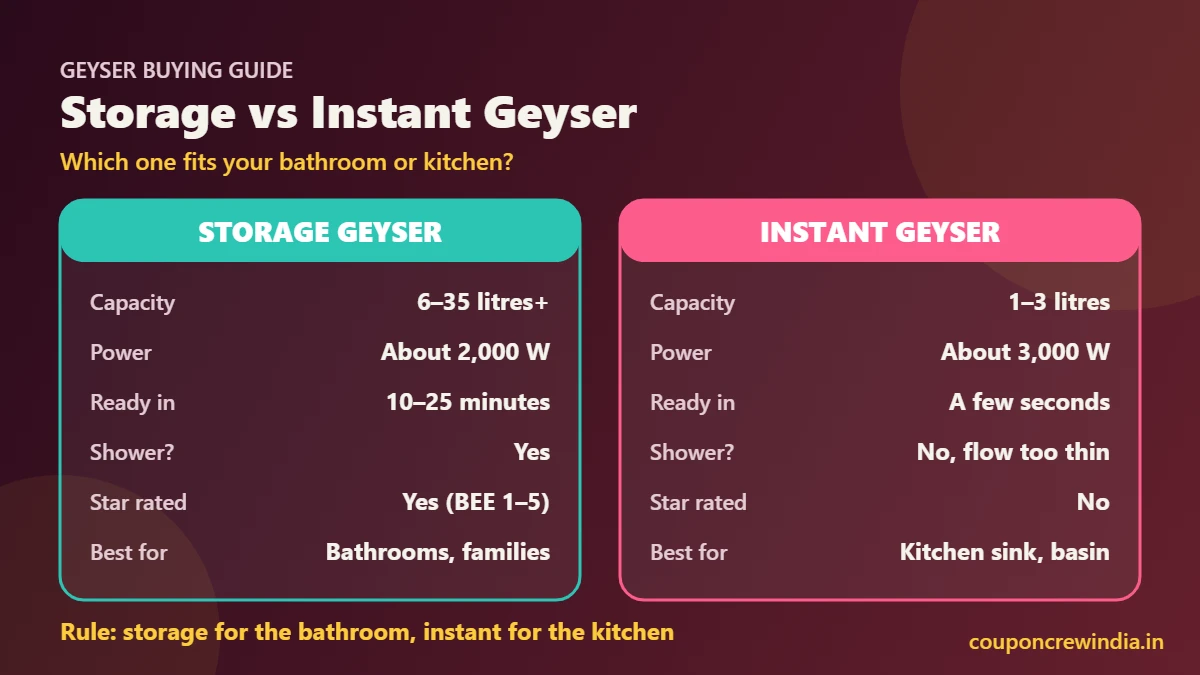
A storage geyser has an insulated tank of 6 to 35 litres or more. It heats the full tank and keeps the water hot for hours. It usually uses about 2,000 watts, so it works on a normal 16-amp socket. This is the best choice for bathrooms, and you can see popular models in the Havells store.
Electric instant geyser (tankless)
An instant geyser holds only 1 to 3 litres. It heats water as it flows, so you get warm water in a few seconds. But it uses around 3,000 watts, and it can only heat a thin flow of water. That is why it is great for a kitchen sink or wash basin, but weak for a shower. Compare small instant models on Croma.
Gas geyser (LPG or PNG)
A gas geyser burns LPG or piped gas to heat water. It gives endless hot water and does not depend on electricity. But it gives off carbon monoxide, which is a deadly gas with no smell. So it must never be fitted inside a closed bathroom. Read our safety section below before you look at gas models on Vijay Sales.
Solar water heater
A solar water heater uses panels on the roof to heat a large tank. It costs more upfront, but the running cost is almost zero on sunny days. It suits independent houses with an open terrace, not most flats. You can browse solar and backup electric models in the home and garden category.
Heat pump water heater
A heat pump works like an AC in reverse. It pulls heat from the air and puts it into the water. So it uses much less electricity than a normal geyser. But it is costly and big, so it is mostly used in large homes and hotels. Check if any premium deals are live on Tata CLiQ.
| Type | Typical size | Power / fuel | Best for | Main drawback |
|---|---|---|---|---|
| Storage (electric) | 6–35 L+ | About 2,000 W | Bathrooms, families | Takes 10–25 min to heat; standby heat loss |
| Instant (electric) | 1–3 L | About 3,000 W | Kitchen sink, basin | Not enough flow for a shower |
| Gas (LPG/PNG) | 6–12 L per minute | Gas + small battery | Homes with PNG and open space | Carbon monoxide risk if badly installed |
| Solar | 100–300 L | Sun (electric backup) | Independent houses | High upfront cost; needs roof space |
| Heat pump | 150 L+ | Electric (very efficient) | Large homes, hotels | Very expensive |
Step 2: Storage vs instant geyser – which is better?
This is the question most buyers get stuck on. The simple rule is this: buy storage for a bathroom and instant for a kitchen. A 3,000-watt instant geyser can only warm about 1.5 to 2 litres per minute by 25°C. But a normal shower uses 6 to 10 litres per minute. So in winter, an instant geyser in the bathroom gives a weak, lukewarm shower. You can compare both types side by side on Reliance Digital.
| Feature | Instant geyser | Storage geyser |
|---|---|---|
| Capacity | 1–3 litres | 6–35 litres+ |
| Wattage | About 3,000 W | About 2,000 W |
| Hot water ready in | A few seconds | 10–25 minutes |
| Good for a shower? | No, flow is too thin | Yes |
| Good for bucket bath? | Only for 1 person, slowly | Yes |
| Standby loss | Almost zero | Yes (lower with 5-star) |
| BEE star label | Not star-rated | Star-rated |
| Approx. price | ₹2,500–₹6,000 | ₹4,000–₹18,000 |
Many homes buy both. They fit a storage geyser in the bathroom and a small instant one in the kitchen. This combo often costs less to run than one big geyser serving both places. Look for combo-friendly deals during the Black Friday sale.
Step 3: How many litres geyser do you need?
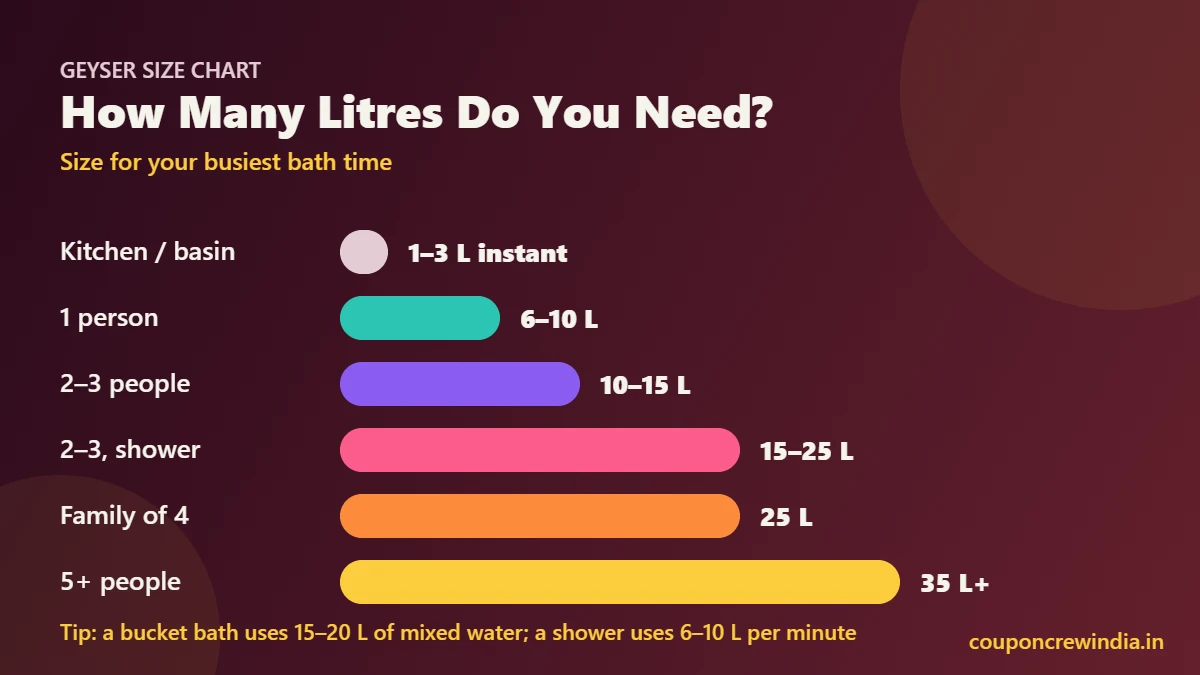
Size your geyser for your busiest bath time, not the whole day. Too small, and the last person gets cold water. Too big, and you pay to heat water nobody uses. A bucket bath uses about 15 to 20 litres of mixed water, but only part of it is hot. A shower uses much more. You can filter geysers by litres on Flipkart once you know your size.
| Who uses it | How you bathe | Recommended size |
|---|---|---|
| Kitchen sink or wash basin | Washing dishes, hands | 1–3 L instant |
| 1 person | Bucket bath | 6–10 L storage |
| 2–3 people | Bucket bath | 10–15 L storage |
| 2–3 people | Shower | 15–25 L storage |
| Family of 4 | Back-to-back baths or shower | 25 L storage |
| 5 or more people | Many showers, one bathroom | 35 L+ storage |
| Bathtub or rain shower | Long, high-flow use | 50 L+ storage |
If you are between two sizes, think about guests and winter. In Delhi and North India, you mix less cold water in January, so you use more hot water. That's why a couple who often have guests may be happier with 15 litres than 10 litres. For a family of 4, a 25-litre geyser is the safe pick, and you can check sizes and prices in the Havells store.
Step 4: Understand the BEE star rating
The Bureau of Energy Efficiency (BEE) gives storage geysers a rating from 1 to 5 stars. The rating is based on standing loss. This is the electricity a full tank loses in 24 hours just to stay hot when no one uses it. Fewer losses mean more stars. So a 5-star geyser keeps water hot longer and switches on less often. Look for "5 Star BEE" in the product title on Amazon.
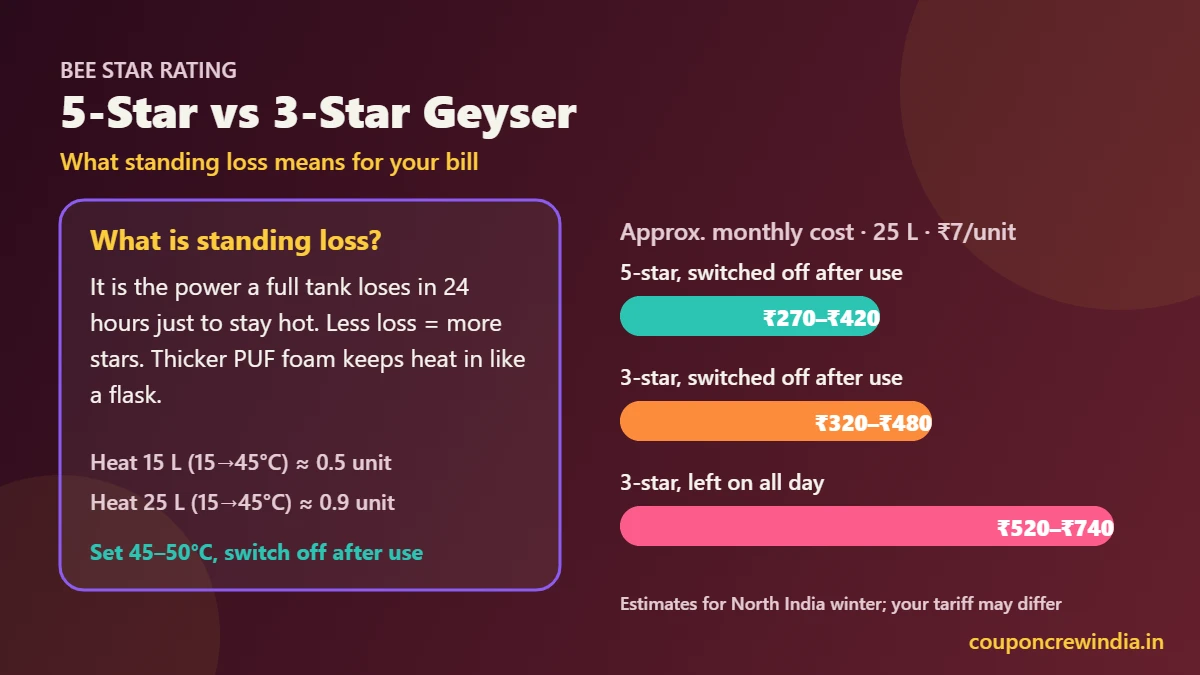
Thicker PUF insulation is the main reason a geyser gets 5 stars. PUF is a dense foam wrapped around the tank, like a flask. Remember that BEE revises its star limits from time to time. So an older 5-star model in a warehouse may be rated lower under the new table. Check the star label year and the standing loss number on the box, or on the official BEE website. Then compare 5-star models on Croma.
How much electricity does a geyser use?
Heating water takes a fixed amount of energy. To heat 15 litres from 15°C to 45°C, a geyser needs about 0.5 units (kWh). A 25-litre tank needs about 0.9 units for the same job. At about ₹7 per unit, that is roughly ₹3.50 to ₹6 for each full heating. The extra cost comes from leaving the geyser on all day, because it keeps reheating to cover standing loss. You can save more by buying smart, so see our tips on the coupons page too.
| Geyser and use | Units per day (approx.) | Cost per month at ₹7/unit (approx.) |
|---|---|---|
| 3 L instant, kitchen, 20 min a day | 0.8–1 | ₹170–₹210 |
| 15 L storage, 2–3 people, switched off after use | 0.8–1.2 | ₹170–₹250 |
| 25 L storage, family of 4, switched off after use | 1.3–2 | ₹270–₹420 |
| 25 L storage, left on all day (3-star) | 2.5–3.5 | ₹520–₹740 |
These numbers are estimates for winter in North India. Your bill depends on your state tariff, cold water temperature and habits. Still, the lesson is clear: switch the geyser off after use, and set the thermostat to 45–50°C instead of 60°C or more. If you are also worried about winter bills from heating your rooms, our room heater guide shows the running cost of each heater type.
Step 5: Pick the right tank for your water
The tank is the heart of the geyser. Most tank damage in India comes from hard water. Hard water has a lot of salts like calcium and magnesium. It leaves white scale on the heating element and inside the tank. Scale makes heating slow and can cause leaks. Cities like Delhi, Gurugram, Jaipur, Chennai and Bengaluru often have hard water. If you see white marks on taps and buckets, treat your water as hard and shop with care on Reliance Digital.
| Tank type | How it works | Hard water? | Tank warranty (typical) |
|---|---|---|---|
| Glass-lined / vitreous enamel | A glass-like coating protects steel from rust | Very good | 5–7 years |
| Titanium or special coated | Brand-specific coating on the tank | Very good | 5–7 years |
| Stainless steel (304/316) | Rust-resistant metal, no coating | Good, but can pit in very hard water | 5–7 years |
| Plain mild steel (cheap local) | Basic painted tank | Poor | 1–2 years |
Other parts that matter for hard water
- Magnesium anode rod: This rod rusts first so your tank doesn't. Replace it every 1–2 years in hard water areas.
- Incoloy or coated heating element: It resists scale and lasts longer than a plain copper element.
- Descaling service: Get the tank flushed once a year before winter.
- Water softener: If your water is very hard, a softener protects the geyser, taps and your skin. Check home and garden deals for one.
Step 6: Safety features you must not skip
A geyser mixes water and high power in a small, wet room. So safety is not optional. Electric storage geysers sold in India must now carry the ISI mark under IS 2082, as per a government Quality Control Order. You can check a licence on the Bureau of Indian Standards website. Then filter for ISI-marked models on Vijay Sales.
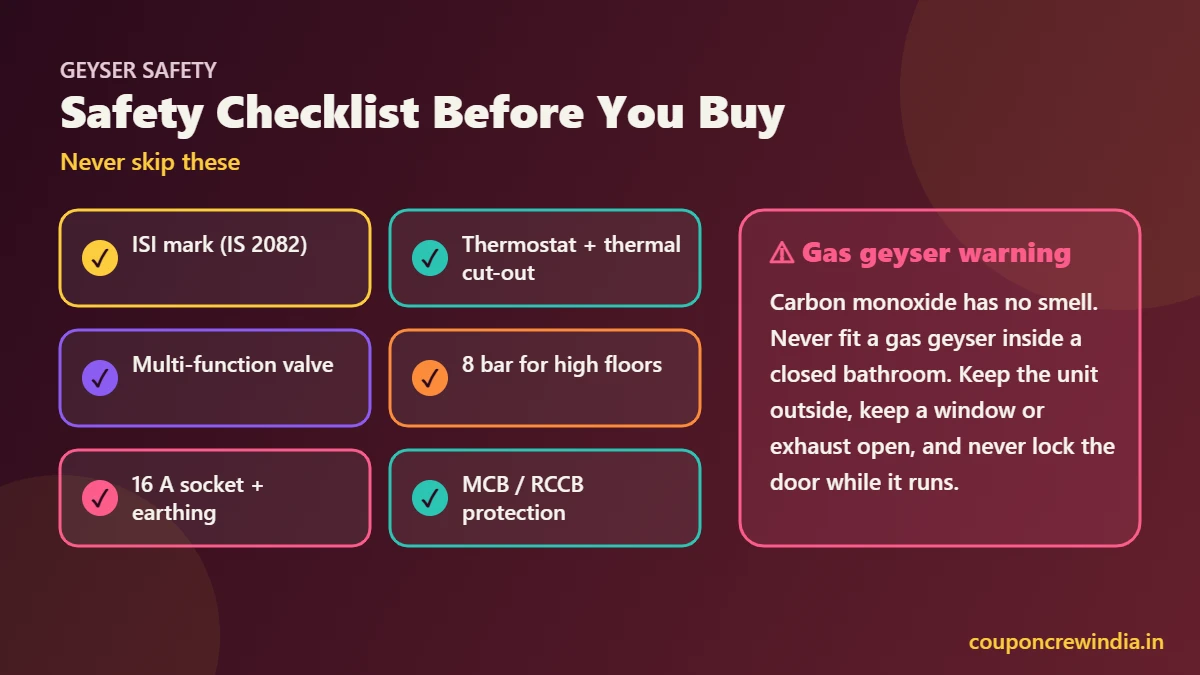
- ISI mark (IS 2082): Shows the geyser passed Indian safety and performance tests.
- Thermostat: Switches the heater off when the water reaches the set temperature.
- Thermal cut-out: A backup switch that cuts power if the thermostat fails and the water gets too hot.
- Multi-function valve: Releases extra pressure and stops hot water from flowing back into the cold pipe.
- Pressure rating: 6.5 bar is fine for most homes. Choose 8 bar if you live on a high floor or use a pressure pump.
- Fire-retardant cord and plug: Lowers the risk of fire from a loose or heated plug.
- ELCB/RCCB in your home wiring: Cuts power in a fraction of a second if there is current leakage. Ask your electrician.
Gas geyser safety: read this before you buy
Every winter, people in India die from carbon monoxide in bathrooms with gas geysers. The gas has no colour and no smell. So the person feels dizzy, faints and may not wake up. The risk is highest when the window is shut and the door is locked. If you choose a gas geyser, fit the unit outside the bathroom in an open space. Bring only the hot water pipe inside. Keep a window or exhaust fan open, and never bathe with the door locked and the gas geyser running. If this setup is hard in your home, an electric storage geyser from the Havells store is the safer choice.
Step 7: Features worth paying for
- Digital display or LED ring: Shows the water temperature so you don't waste power.
- Adjustable thermostat knob: Lets you set 45–50°C to save power.
- Smart or Wi-Fi control: Switch on from bed and set a timer. Useful but not essential.
- Horizontal mounting: Good for bathrooms with low ceilings or a loft.
- Rust-proof plastic body: Lasts longer in a damp bathroom than a painted metal body.
- Long tank warranty: Look for 5–7 years on the tank. The heating element usually has 2–3 years.
Skip "anti-bacterial" or "silver ion" claims unless you trust the brand. They add cost but rarely change daily use. Spend that money on a better tank and a 5-star rating instead, and compare models on Tata CLiQ.
Geyser price in India: what each budget gets you
Prices change often, especially during sales. The ranges below are approximate online prices in late 2026. Use them to judge if a deal is real. Then check the latest prices on Amazon and Flipkart.
| Type and size | Budget range (approx.) | What you get |
|---|---|---|
| 1–3 L instant | ₹2,500–₹6,000 | Kitchen use, plastic body, basic safety |
| 6–10 L storage | ₹4,000–₹9,000 | Single person or small bathroom, 4–5 star options |
| 15 L storage | ₹5,000–₹12,000 | Best seller for couples and small families |
| 25 L storage | ₹6,500–₹18,000 | Family of 4, glass-lined tanks, 8 bar, digital display |
| 35 L+ storage | ₹10,000–₹25,000 | Large families, many showers |
| Gas geyser (6–12 L/min) | ₹4,000–₹12,000 | Endless hot water; needs safe outdoor fitting |
| Solar (100–300 L) | ₹20,000–₹60,000 | Independent houses; very low running cost |
Also budget for installation. Many brands install for free, but they charge for pipes, connectors, a stand or a new socket. This can add ₹500 to ₹2,000. Ask the seller before you order, and check if Croma or your brand offers free fitting in your city.
Best geyser brands in India
Popular brands include Havells, AO Smith, Racold, V-Guard, Bajaj, Crompton, Orient and Venus. All of them sell ISI-marked, star-rated storage geysers. The real difference is the tank coating, warranty and service network in your city. So choose a brand with a service centre near you. You can shop several of these brands through the Havells store, Reliance Digital and all our partner stores.
Which geyser is best for your home?
Use this table to find your match quickly. Then use the filters on Flipkart or Amazon to narrow down models.
| Your situation | Best pick |
|---|---|
| Bachelor or student, small bathroom | 10 L storage, 5-star |
| Couple in a flat | 15 L storage, 5-star, glass-lined |
| Family of 4, one bathroom | 25 L storage, 5-star, 8 bar |
| Joint family, many showers | 35 L+ storage, or two geysers in two bathrooms |
| Kitchen sink only | 3 L instant |
| Hard water city (Delhi, Jaipur, Chennai) | Glass-lined or coated tank + magnesium anode |
| High-rise flat or pressure pump | Storage geyser with 8 bar rating |
| Low ceiling or loft space | Horizontal storage geyser |
| Independent house with terrace | Solar heater with electric backup |
| Rented home | 15 L storage you can take with you; avoid costly fixed systems |
How to install and use your geyser safely
Good installation matters as much as a good geyser. Ask the brand's own technician to install it. Make sure the electrician gives it a separate 16-amp socket and proper earthing. Fix the geyser high on the wall, away from the shower spray. Then follow these daily habits to save power and stay safe. If you are setting up a new home, you can also browse electronics deals for other appliances.
- Switch off the geyser after heating. Don't leave it on all day.
- Set the thermostat to 45–50°C. It is hot enough and safer for kids.
- Switch off the geyser before you pour water on your body, if your wiring is old.
- Get the tank descaled and the anode checked once a year, before winter.
- Replace the geyser if it leaks, trips the MCB often or is over 8–10 years old.
8 geyser buying mistakes to avoid
Most geyser problems come from a few common mistakes. Avoid these and your geyser can run well for close to a decade. Keep this list open when you compare models on Croma or Vijay Sales.
- Buying an instant geyser for a shower. It can't heat enough water per minute in winter.
- Buying too small to save money. The last person in the family ends up with cold water.
- Ignoring hard water. A plain tank can scale up and leak within a few years.
- Skipping the ISI mark. Cheap local geysers may fail basic safety tests.
- Fitting a gas geyser inside a closed bathroom. This is the most dangerous mistake of all.
- Not checking the pressure rating. A 6.5 bar tank on a high-pressure line can burst or leak.
- Using an old 6-amp socket or extension board. The plug can heat up and melt.
- Only checking the product warranty. Check the tank and element warranty separately.
When to buy a geyser and how to save
Geyser prices usually go up as the cold sets in. Demand peaks in December and January, so stock and installers get busy. The smart time to buy is October to November, before the coldest weeks. The Black Friday sale on 27 November is a good chance to grab a deal this year. Summer sales also have low geyser prices, if you can plan ahead.
- Check bank card offers on Flipkart and Amazon. They often add 10% instant discount.
- Compare offline-style prices and free installation at Croma, Reliance Digital and Vijay Sales.
- Buy direct from the brand in the Havells store for longer warranty offers.
- Stack a code from our latest coupons on top of the sale price.
- Ask for an exchange offer on your old geyser. Some sellers give ₹500 to ₹1,500 off.
Winter shopping doesn't stop at the geyser. If the air in your home is smoky this season, our air purifier buying guide can help. For going out, see our winter jacket buying guide.
Geyser buying checklist
Run through this checklist before you click "Buy". It covers every point in this geyser buying guide, so you won't miss anything. Then head to our stores page to find the best price.
- Storage for bathroom, instant for kitchen
- Right size: 10–15 L for 1–3 people, 25 L for a family of 4, 35 L+ for 5 or more
- 5-star BEE label with the latest year
- ISI mark (IS 2082) on the box and product
- Glass-lined or coated tank with magnesium anode for hard water
- 8 bar rating for high floors or pressure pumps
- Thermostat, thermal cut-out and multi-function valve
- 5–7 year tank warranty and a service centre in your city
- Separate 16-amp socket, earthing and MCB/RCCB in your bathroom
- Installation charges confirmed before ordering
- Bank offer or coupon applied
Frequently asked questions
Which geyser is best for home use in India?
For most homes, a 15 or 25 litre electric storage geyser with a 5-star BEE rating and ISI mark is best. It gives enough hot water for baths and showers. You can compare top models on Amazon.
How many litres geyser is good for a family of 4?
A 25 litre storage geyser suits a family of 4, especially if you take showers or bathe one after another. If everyone takes a quick bucket bath, 15 litres can work. Check 25 litre deals in the Havells store.
Is a 5-star geyser worth it?
Yes, for most homes. A 5-star geyser loses less heat, so it switches on less often and keeps water hot for longer. The price gap is small, and you get it back in electricity savings over a few winters. Look for 5-star offers on Flipkart.
Is an instant geyser good for a bathroom?
Only for a small basin or a quick bucket bath for one person. An instant geyser can't heat enough water per minute for a good winter shower. For the bathroom, pick a storage geyser from Croma instead.
How much electricity does a geyser use per day?
A 15 litre geyser uses about 0.5 units to heat a full tank once. A family using a 25 litre geyser may use 1.3 to 2 units a day if they switch it off after use. Leaving it on all day can double this. Save on your purchase with our coupons.
Which geyser is best for hard water?
Choose a geyser with a glass-lined or special coated tank, a magnesium anode rod and an incoloy or coated heating element. Get it descaled once a year. Compare hard water models on Reliance Digital.
Is a gas geyser safe in the bathroom?
Not if the bathroom is closed or has no ventilation. A gas geyser can fill the room with carbon monoxide, which can kill. Fit it outside the bathroom with good airflow, or choose an electric geyser from Vijay Sales instead.
Should I keep the geyser on all the time?
No. Switch it on 15 to 25 minutes before you need hot water, then switch it off. This saves power and is safer. A geyser with a timer or smart control from Tata CLiQ can do this for you.
What temperature should I set on my geyser?
Set it to about 45 to 50°C. This is hot enough for a bath and lowers the risk of burns for kids and elders. Each step down also saves electricity. Find geysers with a clear temperature dial on Amazon.
What is the life of a geyser?
A good storage geyser usually lasts 8 to 10 years with yearly servicing. In very hard water without care, it may fail much sooner. A long tank warranty is a good sign, so check warranty terms in the Havells store.
What is the best time to buy a geyser in India?
October and November are good, because prices rise in peak winter. Big sales like Black Friday, Republic Day and summer sales also bring good deals. Track this year's offers in our Black Friday sale guide.
Do I need a separate MCB for a geyser?
It is strongly advised. A geyser draws high current, so it should have its own 16-amp socket, earthing and ideally its own MCB. An RCCB in your home adds extra shock protection. Plan the wiring before you order from any of our partner stores.
How we researched this guide
We studied the top Google results for geyser buying guides in India, including brand guides, review sites and news reports. We checked the BEE star labelling rules on standing loss and the BIS Quality Control Order that makes the ISI mark mandatory for storage geysers. We read safety reports on carbon monoxide deaths from gas geysers. We also checked current prices and specs for popular models across Indian stores. Running cost numbers are our own estimates using basic heating maths and a sample tariff of ₹7 per unit. For official details, visit the Bureau of Energy Efficiency and the Bureau of Indian Standards. Then compare live geyser deals on our home and garden offers page.